
By Jordan Blum
A Dark Poem, Part III: The Messiah Complex arrives with a lot to prove. Not only is it the conclusion to the already superb namesake trilogy (inspired by Arthur Rimbaud’s 19th century poem about Hamlet’s Ophelia), but also because it follows several other superb LPs that established Green Carnation as Norway’s premier progressive/gothic metal ensemble. Thankfully, it’s a very fitting – if potentially polarizing – finale to what’s likely the band’s most ambitious endeavor yet.
Maintaining what worked so well from 2025’s A Dark Poem, Part I: The Shores of Melancholia and this year’s A Dark Poem, Part II: Sanguis, The Messiah Complex delivers the emotionally charged and eloquently constructed ride fans expect. Its audacious choice to devote virtually half of its runtime to a closing classical instrumental, however, may divide listeners, and ultimately, it’s that choice that’ll truly decide how you feel about the LP on its own and in comparison to its two precursors.
As singer Kjetil Nordhus explains in the official press release, the Dark Poem saga is Green Carnation’s “biggest achievement since Light of Day, Day of Darkness.” Indeed, the roughly two-hour triptych equals (or even surpasses) what the group achieved on their 2001 masterpiece. Plus, Nordhus and bassist/lyricist Stein Roger Sordal were adamant that each chapter worked on its own while having more impact when taken together, and on that front, The Messiah Complex greatly succeeds as both its own thing and as the unifier of the whole Dark Poem project.
The band also say that the bulk of The Messiah Complex features more “rich strokes of prog” amid sustaining its predecessors’ “collective anxiety over encroaching technology, power-hungry leaders and social division.” As for the titular orchestral suite, it “waves in themes from across the trilogy,” and as Nordhus clarifies, they knew it had to be done no matter how others felt about it:
Everyone we’ve talked to is surprised by what we chose to do with the orchestra. It’s a bold statement. But from the moment we started our journey into this trilogy, everyone in the band agreed that we were not going to accept any compromises. To end A Dark Poem with an orchestra and all its capabilities is a very proggy thing to do, like the great bands did back in the late ‘60s.
We’ll get to that track in a bit, but first it’s worth exploring why the first three tunes on The Messiah Complex are business as usual in the best possible ways.
Gratifyingly, opener “Unconditional Artificial Chemistry” finds Nordhus dishing out his trademark anthemic hybrid of dejection and empowerment while surrounded by sophisticated yet fairly straightforward and biting arrangements. Then, “The Messiah Complex” largely channels Green Carnation’s softer, sparser, and proggier side via atmospheric breaks, erratic outbursts, beautifully nuanced instrumentation, mournful singing, and contemplative Biblical songwriting (“A sign that suffers, is due to rejection / A mind that thinks of its own / Judgement is upon you, the Kingdom of Heaven is found at the stairs of a church”). As for “Broken Souls, Common Enemies,” it comes closest to being a ballad, with its vulnerable verses and impassioned choruses being decorated by trepid acoustic guitars, synths, percussion, and other delicate textures. That said, it also features some growling and corresponding metal accentuations (making it the most dynamically wide-ranging piece of the bunch).
As already mentioned, the magnificent (nearly 17-minute) “A Dark Poem – Orchestral Suite” serves as the self-reflective climax of the entire Dark Poem voyage. Beginning subtly with all sorts of symphonic timbres and choral chanting, it expertly interweaves various motifs as it alternates tools and temperaments. It’s undoubtedly a breathtaking and aspiring endeavor full of rich tapestries, but at the same time, listeners who do adore Green Carnation’s typical approaches and/or don’t adore classical music may not be wholly satisfied by – and enamored with – the composition.
As both its own experience and the conclusion to the Dark Poem trilogy, The Messiah Complex is extremely successful at returning to (and building upon) the victories of what came before it. It offers everything Green Carnation devotees could want with its initial tunes, and no matter how atypical and contentious the finale may be for certain people, it’s hard not to admire its daringness, integrity, and sheer splendor. Above all else (and like its predecessors), The Messiah Complex showcases that Green Carnation aren’t slowing down after roughly 25 years; rather, they continue to rank among today’s most reliable, idiosyncratic, and gratifying progressive metal masters.
Order: https://orcd.co/greencarnationadarkpoempart3
Tracklist
1. Unconditional Artificial Chemistry (6:09) [WATCH]
2. The Messiah Complex (6:48)
3. Broken Souls, Common Enemies (8:45)
4. A Dark Poem – Orchestral Suite (16:47)
Full runtime: 38:31
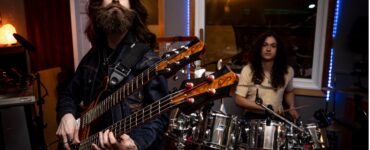
Kjetil Nordhus — Vocals
Stein Roger Sordal — Bass, Keyboards, Rhythm Guitars, Lead Guitars
Endre Kirkesola — Keyboards, Organs, Synthesizers, Effects
Bjørn Harstad — Lead Guitars, Effects
Jonathan Alejandro Perez — Drums