
by Prog Nick
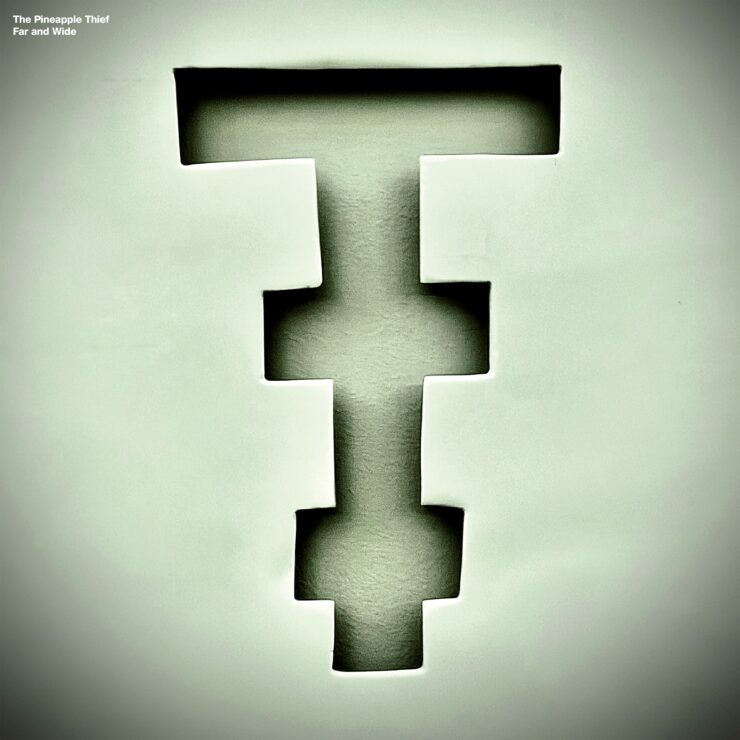
It’s all about connection, really. Connection that is created by a thoughtful balance of musical skill and lyrical emotion. Since 1999, The Pineapple Thief (TPT), led by British Progressive Rock minstrel Bruce Soord, has thus far delivered fifteen albums of very consistent quality to great acclaim. All these albums, to some degree, exhibit some feeling of connection due to Soord’s very particular songwriting, but it is TPT’s sixteenth studio album, 2026’s Far and Wide, that is likely to garner the most attention of all. Because the skill and emotion to be found on this album is elevated to another level. – a level that will create an impenetrable connection with the music. And all you have to do is listen.
The nine songs on the album are quite concise and might even be described as short. With the longest being under 7 minutes, it might seem at first blush that TPT have casually opted to release a collection of singles. But nothing could be further from the truth. Far and Wide is a deeply considered album of connected thematic progressions that are profoundly related. They connect with each other, and they will connect with you.
TPT’s line-up has been consistent since 2017, when Soord (lead vocals, guitar and main composer), Jon Sykes (bass) and Steve Kitch (keyboards) were joined by the astounding Gavin Harrison on drums. As is highly apparent on ‘Far And Wide’, Harrison is very much more than the player seated behind the drum kit. He is a gifted rhythmic and compositional designer. He composes when he plays, and his playing causes the other band members to compose interactively with his drum patterns. There is no doubt that Harrison’s drumming, as technically perfect as it is, is more than just a performance. It contributes creatively to all the song structures and melodies, making him, as he once stated, an ‘ideas man’. Put another way, Gavin Harrison is a generator of musical connections.
But while the resulting ideas are as innovative and original as anything you could wish for, they are never unnecessarily complex. On the contrary, the intention this time around seems to be simplicity and directness, in the form of concise songs that combine into a thematic and emotional complexity on the album level. This intention succeeds beautifully – because the connection is even easier to make.
The album launches straight into an intense modern prog feel with ‘New World Order’. The song has a wonderfully intricate 10/8 groove in which Harrison makes his immediate mark and Sykes confers a similarly inventive bass line,. The track gels and flies from the first second and the scene is well set by it. After that highly impressive start, second track ‘Hold The Ashes’ might easily have brought the tone down, but it does not. Despite the more straightforward time signature and an economical but rugged bass-line, the drum fills and accents are no less ingenious. Sykes’ jagged aggression on the low end is beautifully counterpointed by Soord’s soft, almost buoyant vocals and textured guitar on the high end. With the lyrical theme of ‘scattering ashes far and wide’, it is a dark and sombre composition, but somehow it still has a melodic lightness. I guess that this is by now one of Bruce Soord’s recognisable trademarks – the counterpointing of heavy guitar grooves and pastel melodies.
The pace is slowed by the ballad ‘Still Living’. To begin with, this track seems just good enough not to be classed as filler, but then it is more than rescued by a gorgeous interlude which extracts it from the risk of being labelled just another derivation of Porcupine Tree. After that interlude, the song is fully delivered to grace by a gorgeous guitar solo and outro played in 5/8.
‘God Knows’ has not surprisingly already been released as a single. It is solid and heavy enough, but its composition is, by this album’s standards, just adequate. The song certainly rocks and the playing, of course, is unstoppable, but this is not the song on which the album should be judged. There is much more brilliance to come.
The groan of a tortured guitar opens ‘This Empty Space’, which re-introduces the lyrical theme of ashes – indicating this time that all of us, together with our hopes and dreams, might be lost in those ashes. You can almost see the flakes of ash gently falling from the ether to the earth. Musically, the track is quite triumphant. It has a building suspense and expectation that is created by Harrison’s formidable restraint, Soord’s gentle vocals and the delicate but anguished guitar and keyboard parts.
‘Scattering Like Flies’ is yet another Harrison masterclass in variation, taste, temperance and originality. The song starts off in a foreboding and sinister mood with the pay-off line ‘Something’s got to give, we know’. These gentle but cynical observations soon turn into a heavy and defiant instrumental middle section – almost as a symbol that there will not be resignation or acceptance after all. In this context, Harrison is fully pressed to follow the ebb and flow of the song, which he does wonderfully. The track has peaks and troughs, ambience and weight, and it vacillates with full intent until the whole band combines and connects to make the perfect apex ending.
‘Through The Noise’ similarly builds on a beautiful Steve Kitch keyboard part, but this time to a much darker, heavier and more tormented climax. The lead solo stretches notes and bends them like a tortured soul searching for salvation. You will be breathless by the time Soord’s otherworldly vocal returns to extract you from the anguish. These musical variations are not about volume. Far from it. They are about melody, emotion, instrumental versatility and, ultimately, musical connection.
Penultimate track ‘Who Wants It’ is the story of a paranoid man in a state of mental confusion who will call anyone he can at 4 am to let him out of his misery. The melody is surprisingly poppy in parts, but serpentine Prog-metal variations soon arise, always in service of the song. Each member plays his role to perfection: Soord’s voice reflects a terrible longing; Harrison’s ghost notes and complex kick-drum strikes create perfect symmetry; Sykes’ 16th-note bass riffs are exquisitely chunky and raw and Kitch’s keyboard drone is beyond sinister.
‘No Exceptions’ closes the album with seven minutes of highly accomplished TPT that makes a very strong statement. It contains a sophisticated melody, wonderful chord progressions, yet more fabulous drumming and the mightiest, most yearning guitar crescendo on the album. It is everything you would want from a TPT track, really. But it is the arrangement of this song that makes the strongest statement of all, because, as the lyrics state, ‘Now we understand just what’s been going on,’ and the music fully reflects this catharsis. It is all about resolution, whether lyrically, musically or thematically, and the notion that there is no more need for fear shines through the song in the most connected way, as the last notes of the album fade away into the ether.
While never abandoning TPT’s Progressive Rock aesthetic, ‘Far and Wide’ presents the band at their most direct, dynamic and crisp. All nine songs are strongly integrated over the album’s 48 minutes, without necessarily being part of a ‘concept’. However, central themes, including societal upheaval, personal loss and moral fortitude, do recur to create a composite whole. The album patently succeeds as a singular journey, despite the brevity and singularity of the individual songs. They stand alone, but they also combine to create the album’s overall feeling of connectedness.
The songwriting is succinct, measured, well-paced and subtle. The production is balanced and brisk, and the excellence of the performances is indubitable. You might hear complexity (or perhaps not), but you will never hear self-indulgence. Everything that is played belongs precisely where it is, always respecting the space around it, and good taste is to be heard everywhere.
Far and Wide is an album that has been exceptionally well-crafted. It is considered, prepared, patient and fulfilling, and a lot of this has to do with counterpoints. Beautifully constructed instrumentals create moods of drama and despair, after which Soord’s voice regularly intercedes like a hand reaching out of the shadows. His emotive guitar parts then confer resolution in spades. But all this is done in a way that is never overstated or obvious. There is no unnecessary showmanship here. Every performance, as technical as each might be (especially Harrison’s), serves the composition and the feeling of connection. Every crescendo, climax, solo and drum fill has a considered and thought-out reason for being there. Because ‘Far and Wide’ is not an album about highlights – it is about the moments that connect them. Listen to it from beginning to end – you will feel connected.
Released on Oct. 9th, 2026 on InsideOutMusic
Order here: https://thepineapplethief.lnk.to/FarAndWide-AlbumID
1. New World Order
2. Hold the Ashes
3. Still Living
4. God Knows
5. This Empty Space
6. Scattering Like Flies
7. Through the Noise
8. Who Wants It?
9. No Exceptions
Bruce Soord / lead vocals, guitars
Gavin Harrison / drums
Steve Kitch / synthesizers, keyboards
Jon Sykes / bass, backing vocals





Add comment